
3 Portfolio Projects That Actually Impress in 2026 (And 3 That Scream “Tutorial Follower”)
Why your weather app, to-do list, and Netflix clone are quietly hurting your job search, and what to build instead if you want callbacks.

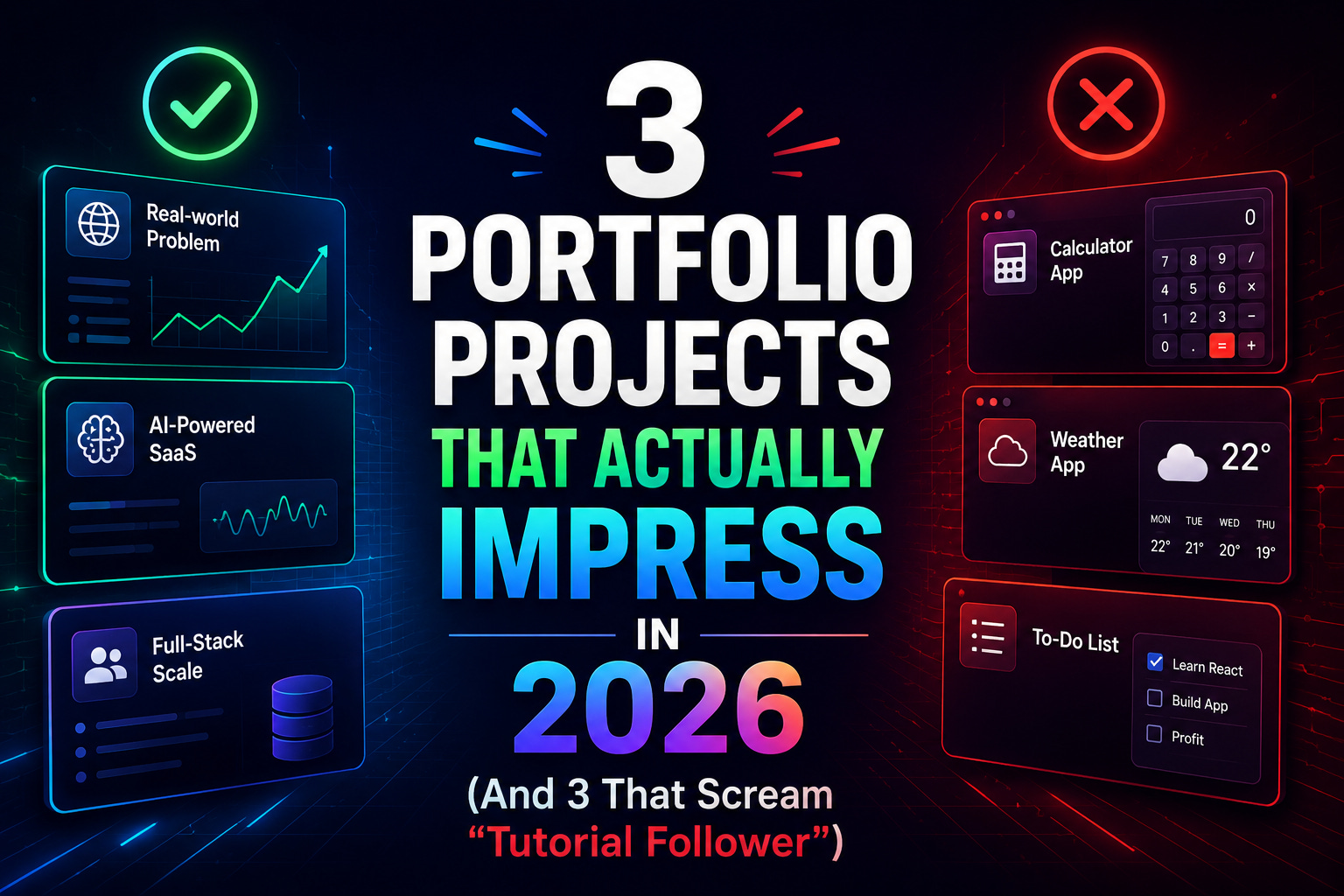
You spent two weeks building a weather app. The UI is clean.
The API integration works.
You deployed it on Vercel. You added it to your portfolio with a nice screenshot.
A recruiter opened your portfolio yesterday. They closed the tab in 8 seconds.
It wasn’t because your code was bad.
It was because they had already seen 47 weather apps that month, and yours didn’t tell them anything new about you.
The portfolio that gets callbacks in 2026 isn’t the one with the cleanest code. It’s the one with the projects that signal who you are as an engineer, not just what tutorials you completed.
This post breaks down which 3 project categories are quietly tanking junior portfolios right now, and the 3 categories you should build instead. Backed by what hiring managers and bootcamp instructors are actually saying about portfolios in 2026.
Why this matters more than your résumé
The job market for junior developers in 2026 is brutal in a way previous classes didn’t face.
Entry-level postings in software development have dropped sharply since 2023, with junior tech roles in particular seeing some of the steepest declines across the broader hiring slowdown.
When postings shrink, recruiter time per candidate also shrinks. Your portfolio, more than your résumé, is doing the heavy lifting of distinguishing you from a hundred other applicants for the same role.
Here’s the part most juniors miss: the projects you build are also a signal of taste. Hiring managers don’t just check whether you can code. They check whether you understand what’s worth building.
A polished weather app says you can follow instructions.
A scrappy tool that solves a real annoyance says you have judgment.
Judgment is what gets hired in 2026, because anyone with a Copilot subscription can produce code.
The 3 Projects That Are Quietly Hurting Your Portfolio
These aren’t bad projects to learn from.
They’re great learning projects.
The problem is putting them in your portfolio as evidence that someone should hire you. They’ve been built so many times that recruiters can’t extract any signal from them.
1. The Weather App
Every bootcamp graduate builds one. Every front-end course suggests it as a final project.
Recruiters know this. When they see one in your portfolio, they don’t think “this person can call APIs and render data.” They think “this person did the standard tutorial.”
The technical skills it demonstrates are genuinely useful: API integration, async data handling, basic state management, and clean UI.
The problem is that those skills are now baseline expectations, not differentiators.
A weather app proves you cleared the bar. It doesn’t prove you cleared anything else.
The deeper issue: a weather app solves no real problem. There are 50 weather apps better than yours that anyone can install for free.
The project tells the recruiter you built something for the sake of building it, which is exactly what tutorials are for, not what jobs are for.
2. The To-Do List
The to-do list has become the universal “I learned a new framework” project.
Every React tutorial uses it. Every Vue tutorial uses it. Every Svelte tutorial uses it.
Recruiters have seen so many of them that they’ve stopped looking past the headline.
What it demonstrates is genuine: CRUD operations, state management, local storage, basic UX patterns.
What it doesn’t demonstrate is product thinking.
The to-do list is a problem so well-solved that there are dozens of free apps doing it better than your version ever will. Building one signals that you wanted a project that was easy to scope, not that you wanted to make something useful.
If you absolutely must build a to-do list, build one with a real twist.
A to-do list integrated with your calendar that auto-schedules tasks based on your free time, for instance, is no longer a to-do list. It’s a productivity tool with a problem statement, and that distinction matters.
3. The Netflix or Spotify Clone
This category includes any “clone” project: Netflix, Spotify, Twitter, Instagram, Airbnb, anything where the goal is to recreate an existing service’s interface and basic functionality.
Clone projects feel impressive while you’re building them because the source material is impressive. They look polished because you’re copying polished design.
The problem is that recruiters can tell within seconds when they’re looking at a clone, and the signal it sends is uniformly negative.
Clone projects answer the question “can you copy something?”
The question recruiters are actually asking is “can you build something I haven’t seen before?”
There’s also a credibility problem.
Anyone who has spent time on YouTube knows that Netflix clones are the single most popular tutorial topic on the platform. Putting one in your portfolio is, intentionally or not, telling the recruiter you followed a popular video tutorial.
The 3 Project Categories That Actually Get Callbacks in 2026
Now the part that matters more. These categories aren’t specific projects. They’re shapes of project that consistently signal the things hiring managers are looking for.
1. A Tool That Solves a Real Annoyance in Your Own Life
This is the single highest-impact project category for junior portfolios in 2026.
Bootcamp instructors at programs like Codeworks have been advising graduates that side projects showing initiative and curiosity (especially ones that push beyond the curriculum) are the most memorable parts of any portfolio.
The criteria are simple. The project should solve a problem you actually had, however small. Examples that work:
A scraper for a website that lacks the feature you need: if your local government posts bus schedule changes as PDFs and you built a tool that converts them to a usable format, that’s a project with a story
An automation script for a chore in your own life: a script that moves screenshots into dated folders, downloads your bank statements monthly, or organizes the chaos in your downloads folder
A tool a family member or friend actually uses: a budget tracker your sibling uses for their freelance income, a workout logger your roommate uses at the gym, a meal planner your parent uses every Sunday
The “yes, my mom uses this” project is disproportionately impressive because it carries a story. You can talk about who has the problem, what they tried before, what your tool does differently, and what you’ve changed based on their feedback. That’s a product conversation.
Hiring managers want to hire people who can have product conversations.
Tutorial projects can’t carry one.
2. A Real Open-Source Contribution
A single merged pull request to a real open-source project is worth more than five solo projects. This is one of the most consistent points across recent advice from hiring managers and bootcamp programs writing about junior portfolios in 2026.
The reason is structural.
An open-source contribution proves something a solo project never can: you can navigate an unfamiliar codebase, follow someone else’s conventions, accept feedback from maintainers you don’t know, and ship work that fits into a system you didn’t design.
Those are the exact skills you’ll be using on day one of any real job, and most juniors have no evidence of any of them.
The contribution doesn’t have to be large.
Look for issues labeled “good first issue” on GitHub repositories you actually use.
Fix a small bug.
Improve documentation that confused you when you were learning.
Add a missing test case.
The contribution is documented, time-stamped, publicly visible, and, most importantly, accepted by maintainers who didn’t know you.
That’s social proof you can’t fake.
If “open source” feels intimidating, start by contributing to a tool you use regularly. The library that powers a feature in your portfolio.
A CLI you depend on.
A documentation site that has a typo.
The mindset shift from “I build things alone” to “I work within existing systems” is what employers are paying for.
3. A Tiny AI-Integrated Feature in a Real App
This is the 2026-specific project category.
The other two are evergreen advice.
This one is the one that signals you understand the moment you’re entering the industry in.
The mistake juniors make here is overreach. They try to build “an AI startup” or “a chatbot.”
Those projects fail in portfolios because they’re either obviously thin (a wrapper around the OpenAI API) or obviously beyond what a junior can ship well.
What works instead is a tiny, useful AI feature embedded in a project that already has a reason to exist. Examples:
A semantic search bar over a small set of documents you actually need to search: like your own notes, your team’s wiki, or a public dataset
An auto-summarization feature in a tool that processes long-form content: like a meeting notes app, an article reader, or a customer feedback dashboard
A smart classification feature where AI assigns categories or tags: in a budgeting app, an expense tracker, or a content management tool
The criteria for a good “AI feature” project: the AI is doing something specific and bounded, the rest of the app would still be useful without it, and you can clearly explain why an LLM is the right tool for that one piece.
That trio of qualities signals you understand AI as a tool, not as a magic solution. That signal is exactly what 2026 hiring managers are scanning for.
What this checklist won’t fix
A few things worth being honest about, because not everything is a project problem.
Bad commits and a messy GitHub: if your repos have commit messages like “fixed stuff” and no READMEs, no project category will save you. Your GitHub profile is part of your portfolio, often the most-checked part. Clean it before you swap projects.
A portfolio with 12 projects: more is not better. Three excellent projects, each with a clear story and a real reason to exist, beat 12 unremarkable ones every time. If you have 12 projects in your portfolio right now, your homework is to delete 9 of them.
The first interview: even the best portfolio gets you to the interview. After that, you have to be able to talk about your projects with depth and honesty. Build projects you genuinely care about, because you’ll be discussing them under pressure.
What to do this week
Pick one project to retire from your portfolio.
The weather app, the to-do list, the Netflix clone, whichever one has been sitting there longest.
Take it down.
Replace its slot with a placeholder that says “in progress.”
Then write down 3 specific friction points in your own week.
The smallest one is your next project. Start it this weekend.
The portfolio that gets callbacks isn’t the one that took the longest to build. It’s the one that tells a recruiter, in 30 seconds, that you have judgment about what’s worth making.
The best portfolio project is the one your friend uses on a Tuesday.