
The Future of AI Work Is Not Better Prompts. It Is Better Workflows.
Why the next valuable AI skill is designing clear, reliable processes instead of chasing perfect prompts

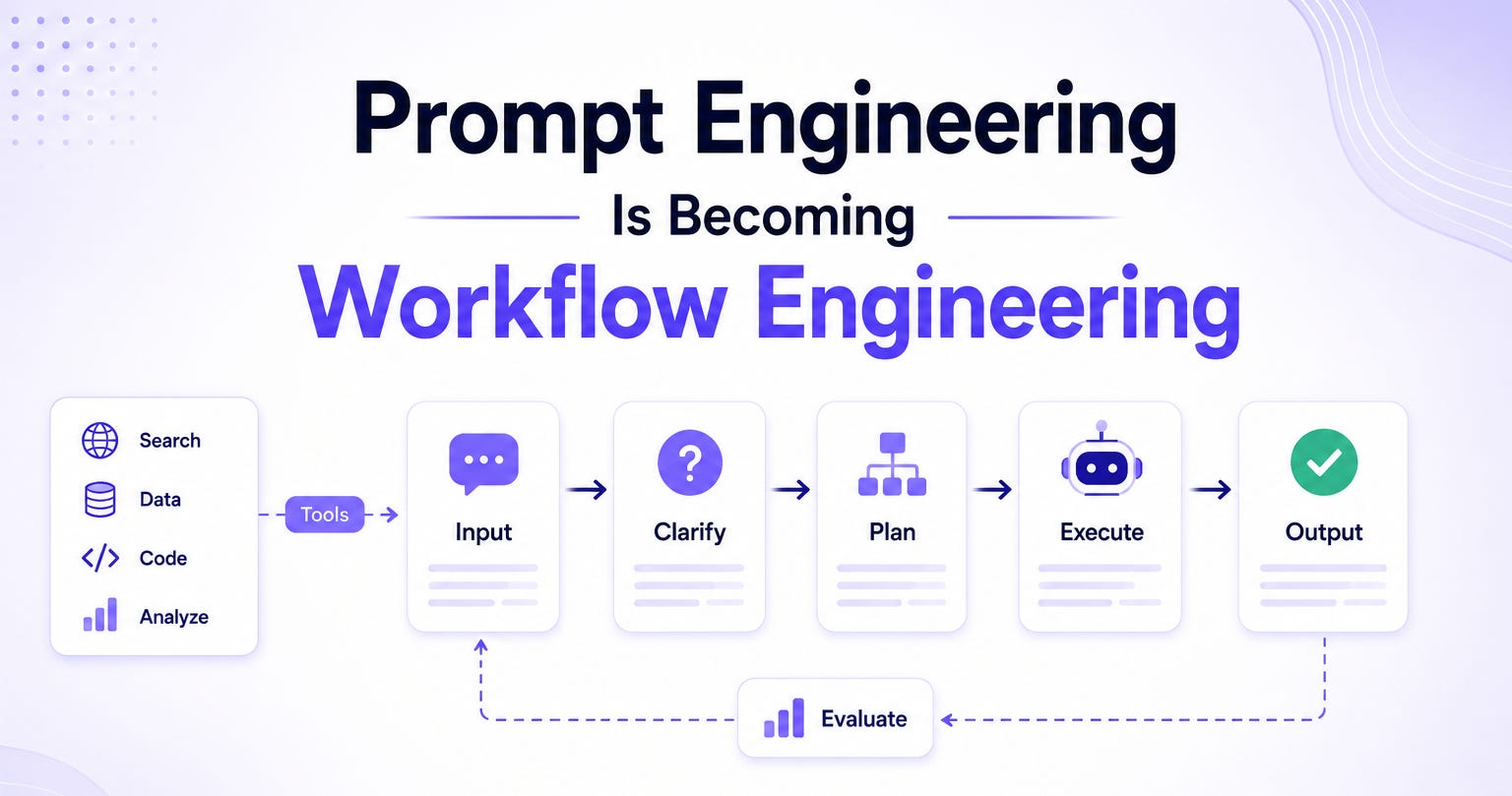
A couple of years ago, the valuable skill was writing the perfect prompt.
People traded phrasings like trading cards, collected libraries of magic words, and argued over whether “you are an expert” belonged at the start of every request.
The premise was that the right incantation would pull a great answer out of the model, and getting the wording right was most of the game.
For a while, that premise held, because the models were finicky enough that phrasing genuinely mattered.
That era is ending, and something more useful is replacing it.
The models got good enough at understanding plain intent that clever phrasing stopped being the differentiator, and at the same time they got capable enough to do multi-step work: using tools, holding context across a project, taking several actions toward a goal.
The result is that the frontier of skill has moved. It is no longer about crafting one perfect prompt. It is about designing a sequence of steps that accomplishes something larger, which is a different discipline.
Prompt engineering is becoming workflow engineering.
This is not the death of the prompt.
The individual prompt still matters, the way a single well-written sentence still matters inside a good document. But the sentence is no longer the unit of value.
The document is.
This post is about that shift: why it is happening, what workflow engineering actually is, and why it is good news, especially for people who never wanted to memorize magic words in the first place.
Why the Single Prompt Stopped Being the Point
The original case for prompt engineering rested on a weakness in the models. Early tools were sensitive to phrasing in ways that felt almost superstitious.
The same request worded two ways could produce a useful answer or a useless one, so learning the wordings that worked was a real edge.
Prompt engineering, in that world, was partly a craft and partly a workaround for models that did not yet understand what you meant.
As the models improved, that weakness faded.
Newer models are much better at understanding plain intent, which means a clear, ordinary request now works about as well as a carefully engineered one.
The magic words stopped being magic, because the model no longer needs them to grasp what you want. You can ask for things the way you would ask a competent colleague, and it mostly works.
The skill of finding the special phrasing depreciated, not because prompting stopped mattering, but because the thing that phrasing was compensating for largely went away.
What remained, once the phrasing tricks stopped mattering, was the part of prompting that was never really about words: being clear about what you actually want, and giving the model the context it needs.
That part is durable.
But it turns out to be a small piece of a larger skill, which is what becomes visible once you look at what real work actually requires.
Why Workflows Became the Frontier
Two things pushed the frontier from prompts to workflows at the same time.
The first is that the models became able to do multi-step work. They can use tools, search the web, run code, pull from connected apps, hold a set of files and instructions across a whole project, and take several actions in sequence toward a goal.
A tool that can only answer one question at a time rewards good questions.
A tool that can carry out a multi-step process rewards good processes.
As the tools gained the ability to do more than answer, the value moved to designing what they should do.
The second is that real work was always multi-step, and a single prompt was never a good match for it.
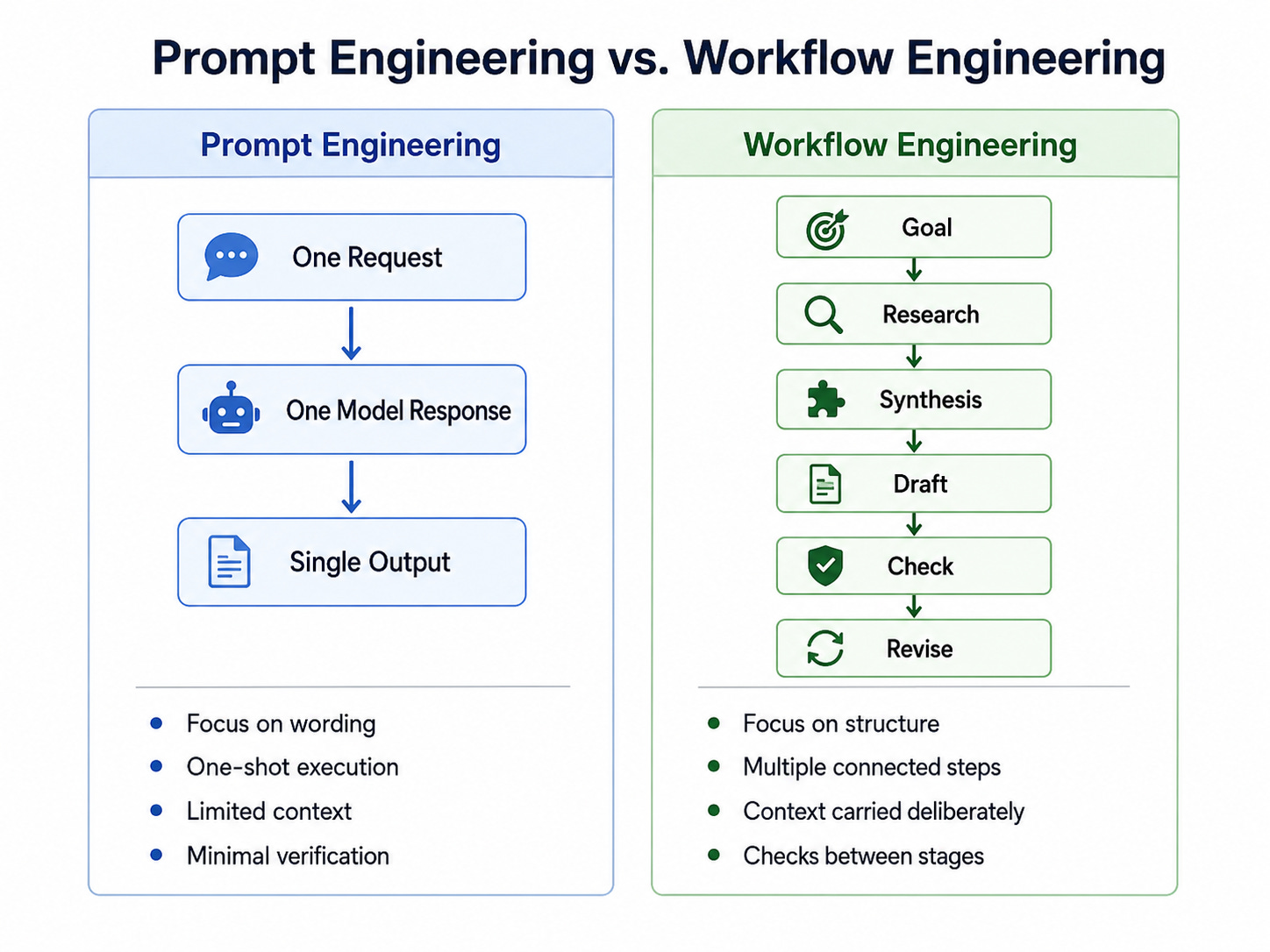
A single prompt produces a single output. But the actual jobs people need done are not single outputs.
Researching a topic and producing a report is many steps: gather sources, pull the relevant findings from each, synthesize them, draft, check, revise. Handling a recurring task is a process with stages.
Almost anything worth doing has structure, and structure is exactly what a lone prompt cannot provide.
The mismatch was always there. It only became obvious once the tools were capable enough that the workflow, not the prompt, was the thing holding you back.
Put together, these mean the interesting question changed. It used to be “what do I type to get a good answer.”
Now it is “what is the sequence of steps, with the right context and checks at each one, that gets this whole thing done well.”
That second question is workflow engineering.
What Is Workflow Engineering
Workflow engineering sounds technical, but the core of it is not. It is the skill of taking a goal and designing the steps that reach it, deciding what each step needs, and connecting them so the whole thing works.
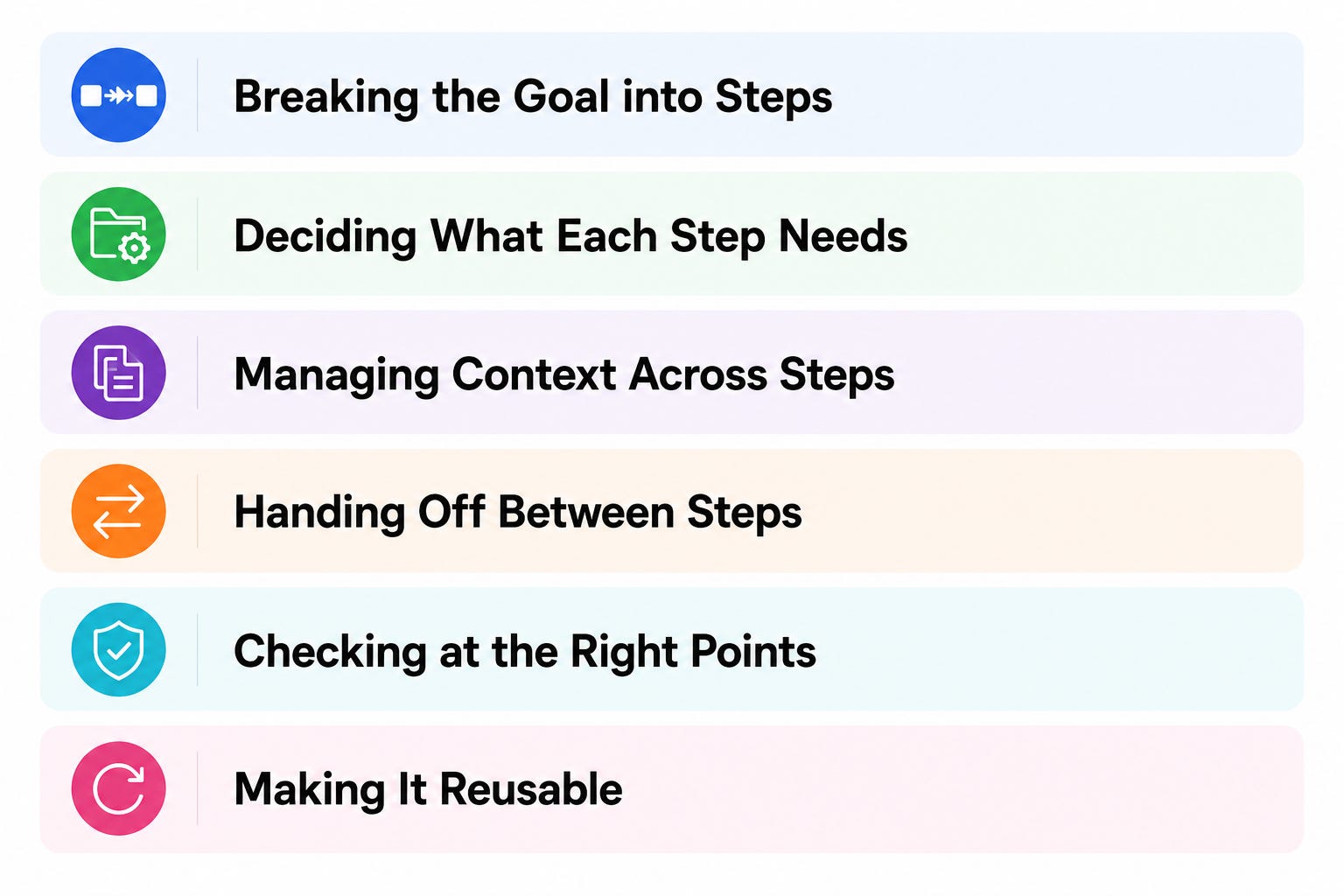
Its main parts are these:
Breaking the goal into steps: taking “produce a competitive analysis” and turning it into the actual sequence of smaller tasks that produce one. This decomposition is the heart of the skill, and it is the part the AI is worst at doing for you, because it depends on knowing what you actually want.
Deciding what each step needs: what context, what files, what tools, and sometimes which model. A step that needs to search the web is different from one that needs to reason carefully over a document, and matching each step to what it requires is part of the design.
Managing context across steps: deciding what carries forward from one step to the next and what gets left behind. A workflow that drags all its accumulated context into every step gets slow and muddled, so knowing what each step actually needs to know is its own small skill.
Handing off between steps: the output of one step becomes the input to the next, and designing those handoffs cleanly is what makes a workflow flow rather than stall.
Checking at the right points: deciding where to verify before moving on, so an error in step two does not silently propagate through steps three, four, and five. The checkpoints are where human judgment stays in the loop.
Making it reusable: turning a workflow that worked into something you can run again, through a saved project, a set of standing instructions, or an automated setup, so you build the process once and reuse it.
None of these are about phrasing.
They are about structure, sequence, and judgment, which is why this is a genuinely different skill from prompt engineering, and a more valuable one.
The Same Task, as a Prompt and as a Workflow
The difference is clearest in a concrete case.
Take producing a research report on a market or a topic.
The prompt approach is one request: “Write me a detailed report on this market.”
The output is a single generated document, and it is almost always mediocre. It is generic, because the model produced it in one pass from its general knowledge, with no real sources, no verification, and no structure beyond what it could generate on the spot.
You can improve the prompt, but you are still asking one step to do a job that has many.
The workflow approach treats it as the process it actually is.
First, gather real sources into a project.
Second, pull the key findings from each source, with citations.
Third, synthesize across the sources, surfacing where they agree and disagree.
Fourth, draft the report from that synthesis.
Fifth, have the draft critiqued for weak spots.
Sixth, revise. Each step is a focused request, the context carries forward through the project, and you check the output between steps.
The result is a report grounded in real sources, structured deliberately, and verified along the way, which is a different quality of output entirely.
The individual prompts in that workflow are ordinary. None of them is a work of prompt-engineering art.
The quality comes from the structure: the right steps, in the right order, each given what it needs, with checks in between. That is the shift in a single example.
The value moved from the cleverness of the prompt to the design of the process.
The Skill Underneath Is the Durable One
The good part of this shift is what it says about which skills last.
Prompt phrasing was always a shallow skill, tied to the quirks of particular models, and it depreciated as the models changed.
Workflow thinking is a deep skill, tied to the structure of the work itself, and it does not depreciate, because the work still has structure no matter how the tools evolve.
Breaking a goal into steps, knowing what each step needs, sequencing them, and checking the results is essentially process design, and process design is a general skill that predates AI by a long way. It is what good project managers, operators, and organizers have always done.
The AI tools are new, but the thinking that makes them produce good results is the same thinking that has always turned a vague goal into a reliable outcome.
Learning it now, in the context of AI, is learning something that will keep its value as the specific tools come and go.
This is why chasing prompt libraries and magic phrases is a poor investment of attention at this point.
Not because prompting does not matter, but because the phrasing tricks were the depreciating part, and the durable part was never the phrasing.
The durable part is knowing how to structure the work, which no prompt library can give you, because it is a way of thinking rather than a list of words.
Why this Is Good News If You Don’t Code
There is a common worry that as AI gets more capable, getting good results will require more technical skill, not less.
The shift to workflow engineering suggests close to the opposite, at least for the kind of work most people do.
Workflow thinking is not a coding skill. It is a thinking skill, and specifically it is the kind of thinking non-technical people who organize work, run projects, plan events, or manage processes are often already good at.
Deciding what steps a goal requires, what each step needs, and where to check the results is the same competence that runs any multi-step effort, with or without AI.
If you have ever planned something complicated and made it actually happen, you have done workflow engineering. Pointing that skill at AI tools is a small step, not a technical leap.
This means the barrier to getting real value from AI is dropping into territory that favors clear thinkers over technical specialists.
The person who can look at a goal and see the sensible sequence of steps has the skill that now matters most, and that person does not need to write a line of code.
The tools handle the execution. The human handles the design, and the design is a thinking task, not a technical one.
What to Actually Do Differently
The practical shift is to stop optimizing prompts and start designing processes.
When a task disappoints, the old instinct was to reword the prompt.
The better instinct now is to ask whether the task should have been one step at all.
Often the fix is not a better prompt but a better breakdown: two or three focused steps instead of one overloaded request, with the right context at each and a check in between.
The question moves from “how do I word this” to “what are the steps, and what does each one need.”
The individual prompt still matters as a component.
Within a workflow, a clear, well-specified step still produces a better result than a vague one, so the prompting skills that survived the shift, being clear about what you want and supplying the right context, still apply at every step. But they apply in service of the workflow, not as the whole game.
You are writing good sentences inside a well-structured document, not hunting for one perfect sentence and hoping it carries the whole thing.
The Honest Limits
A few cautions, so the idea does not get oversold.
Prompt engineering is not dead, it is absorbed. The clear-request-with-good-context skill is now a part of workflow engineering rather than a discipline of its own.
Anyone telling you prompting no longer matters at all is overstating it. It matters, at every step, as a component.
Not everything needs a workflow either.
A simple question is still one prompt, and building a six-step process for a task that a single clear request handles is its own kind of waste.
The skill includes knowing when a workflow is warranted and when it is overkill, and most quick tasks are overkill for it.
A workflow can be two steps. It does not need to be an elaborate automated machine to count.
And a workflow still needs human judgment, especially at the checkpoints.
The appeal of handing an entire multi-step job to an AI agent and walking away is strong, and it is mostly premature.
The reliable pattern is a workflow you designed and supervise, checking the results at the points that matter, not one you trust blindly end to end.
The human moved from writing the prompts to designing and overseeing the process, which is more responsibility, not less.
The through-line is simple.
The skill that mattered was making one prompt work. The skill that matters now is making a sequence of steps work together toward something larger.
The prompt became a component, and the design of the whole became the craft.
For anyone who found the magic-words era faintly ridiculous, this is a welcome change, because the thing that now matters most is not a trick at all. It is the old, durable skill of knowing how to turn a goal into a process that actually reaches it.