
The Difference Between Agentic AI, Generative AI, and LLMs Explained
Agentic AI vs generative AI vs LLMs explained for beginners: what each term actually means, how they relate, and why they're not synonyms.

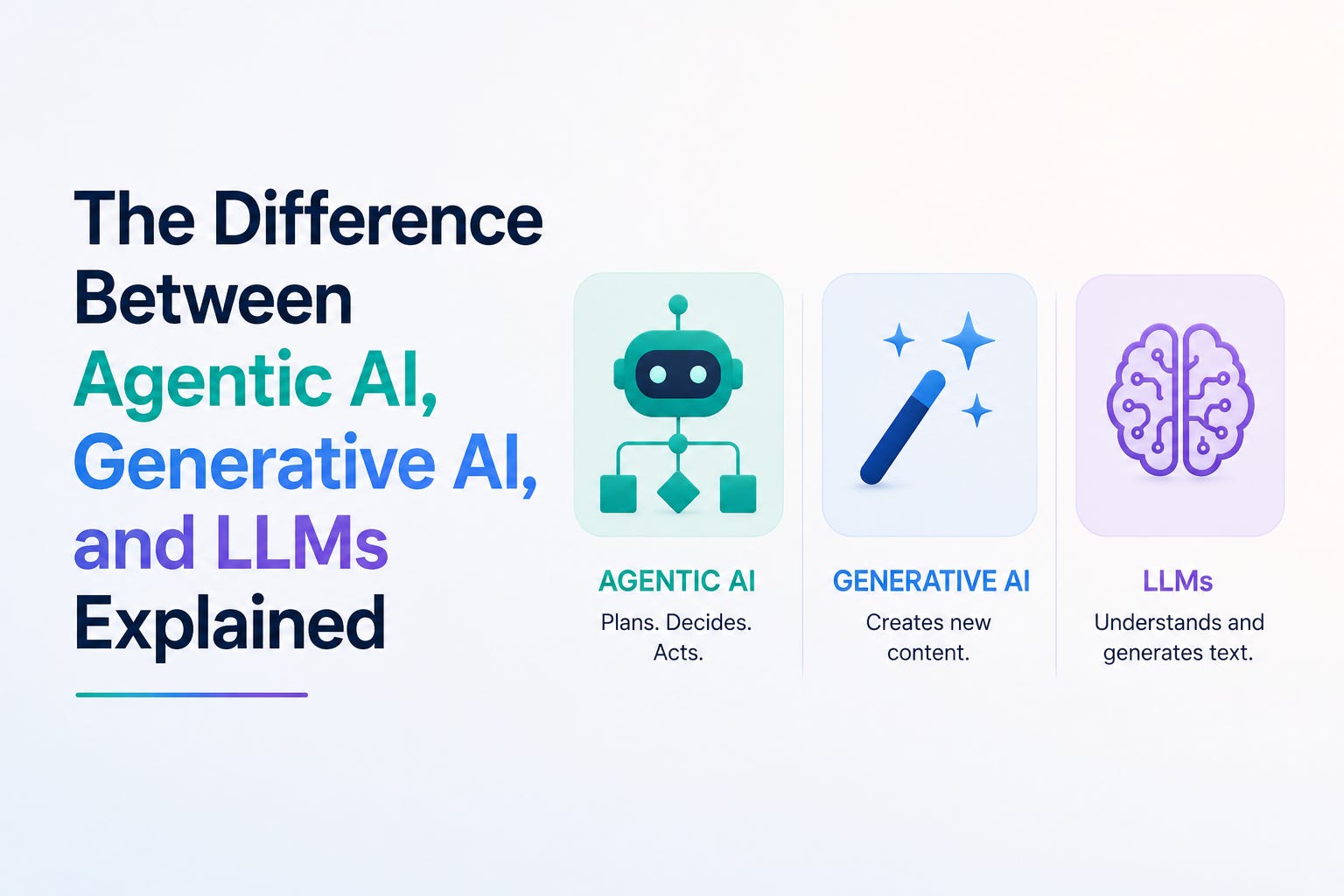
A specific kind of confusion has become common as AI terminology spread into everyday conversation.
Three terms (LLMs, generative AI, and agentic AI) get used as if they’re interchangeable, when they actually describe different things at different levels.
Someone says “generative AI” when they mean an LLM. Someone says “AI agent” when they mean a chatbot.
The terms blur together, and the blurring makes it hard to understand what any particular AI product actually is.
The confusion is understandable.
The three terms are related, they overlap, and the marketing around AI products uses them loosely. But they aren’t synonyms, and the differences matter for understanding what a given tool can and can’t do.
An LLM, generative AI, and agentic AI describe progressively broader and more capable things, and seeing how they nest together clears up most of the confusion at once.
This post untangles the three terms with simple definitions and concrete examples.
The goal is that by the end, anyone reading should be able to hear one of these terms used and know which thing is actually being described, rather than nodding along while the terms blur together.
The relationship turns out to be cleaner than the loose usage suggests.
The quick version
Before the detailed explanations, the relationship in one paragraph:
An LLM is the underlying technology (a system that works with text).
Generative AI is the broader category of AI that creates new content, of which LLMs are one type.
Agentic AI is a way of using AI (often an LLM) to take actions and complete tasks, not just produce content.
They’re not three competing things.
They’re three different levels: a specific technology, a category that includes it, and a way of applying it.
The rest of this post explains each one and how they fit together.
LLM: the underlying technology
An LLM (Large Language Model) is the specific technology underneath most of what people interact with when they use AI in 2026. It’s a system that learned patterns from enormous amounts of text and uses those patterns to predict and produce text. ChatGPT, Claude, and similar tools are built on LLMs.
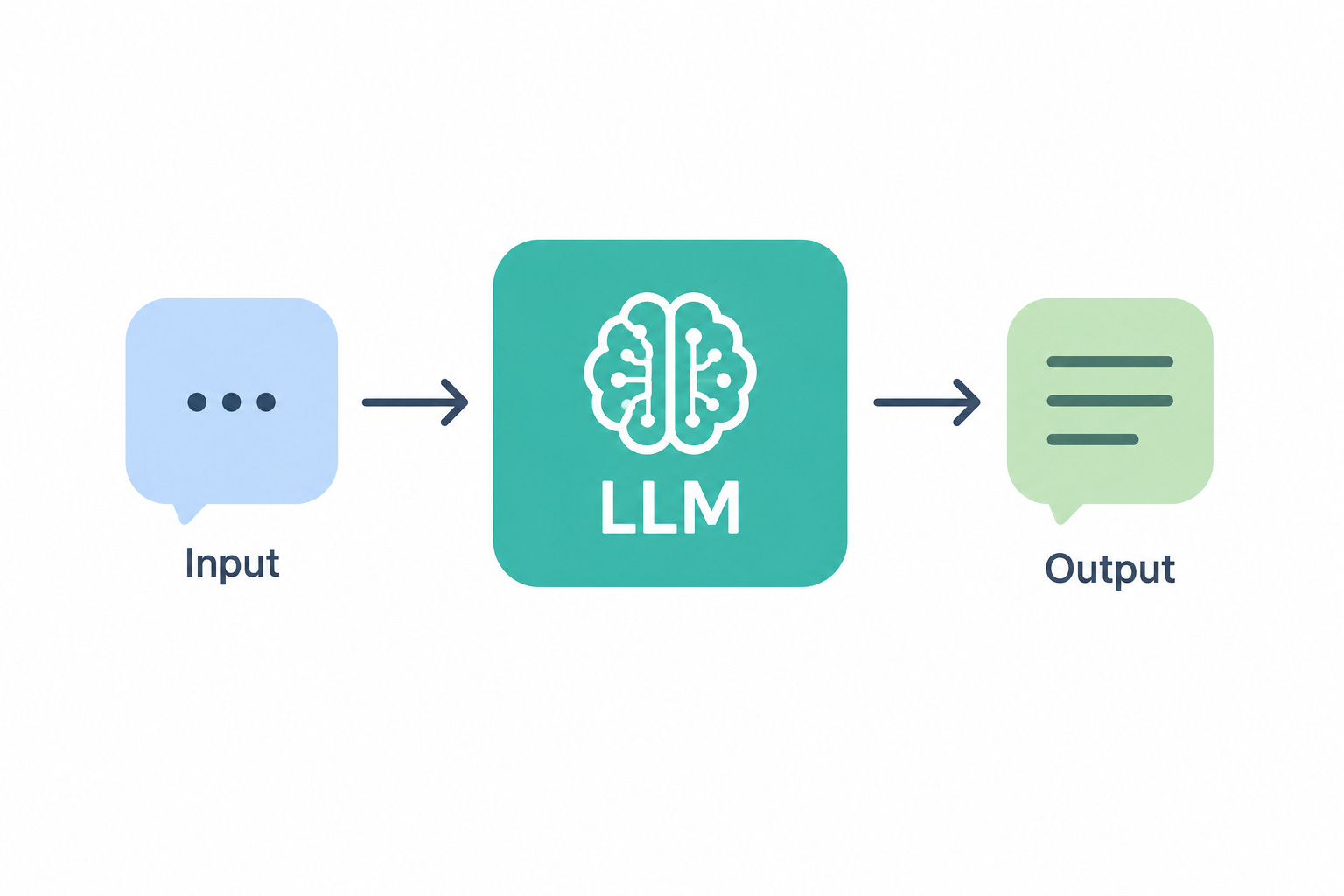
The key thing about an LLM is that it works with text.
Text goes in, text comes out. It’s the engine, the core component that does the actual language work.
When someone asks ChatGPT a question and gets an answer, an LLM is what produced the answer.
LLMs are the most specific of the three terms. They refer to a particular kind of technology, not a category or a usage pattern.
Saying something “is an LLM” is like saying a vehicle “is a gasoline engine.” It names the specific technology, not the broader category or what the technology is used for.
A few examples of LLMs in action:
A chatbot answering questions: the LLM produces the answers
An autocomplete tool suggesting the next line of code: the LLM predicts the likely continuation
A summarization feature condensing an article: the LLM produces the summary
In all these cases, the LLM is doing the same fundamental thing: working with text based on patterns it learned.
The applications differ, but the underlying technology is the same.
Generative AI: the broader category
Generative AI is a category, broader than LLMs. It refers to any AI that creates new content, rather than just analyzing or classifying existing content.
The “generative” part means it generates, it produces something new.
LLMs are one type of generative AI, the type that generates text.
But generative AI includes other types that generate other kinds of content:
Image generation: AI that produces images from text descriptions
Audio generation: AI that produces music or speech
Video generation: AI that produces video clips
Code generation: which is really text generation applied to code, usually done by LLMs
So generative AI is the umbrella, and LLMs are the part of the umbrella that handles text. All LLMs are generative AI (they generate text), but not all generative AI is LLMs (image generators are generative AI but not LLMs).
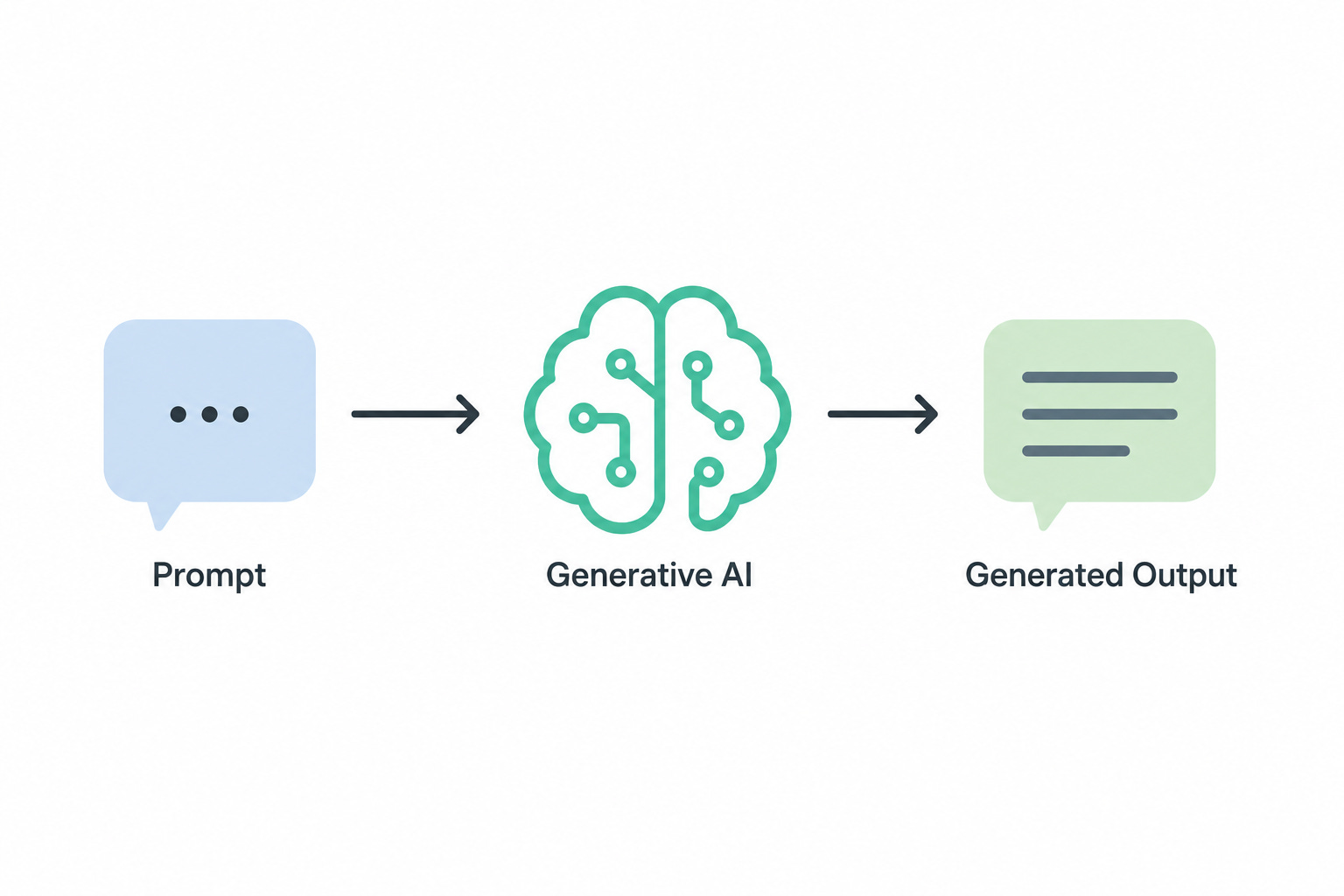
The relationship is one of category and member.
“Generative AI” describes the category of content-creating AI.
“LLM” describes a specific member of that category.
When someone says “generative AI,” they might mean an LLM, or they might mean an image generator, or they might mean the whole category.
The word itself doesn’t specify which, which is part of why it gets used loosely.
The contrast that defines generative AI is with AI that doesn’t create content.
A spam filter that classifies emails as spam or not-spam is AI, but it’s not generative, because it’s categorizing rather than creating.
A recommendation system that picks which video to show next is AI, but not generative.
Generative AI specifically creates new content, which is what distinguishes it from these older, non-generative kinds of AI.
Agentic AI: a way of using AI
Agentic AI is the third term, and it describes something different from the other two. It’s not a specific technology (like an LLM) or a category of output (like generative AI). It’s a way of using AI to take actions and complete tasks, not just to produce content.
The core idea of agentic AI is that the AI doesn’t just respond to a request with content. It works toward a goal across multiple steps, deciding what to do next based on what it’s trying to accomplish.
An agentic AI can use tools, make decisions, take actions, and continue working until a task is complete.
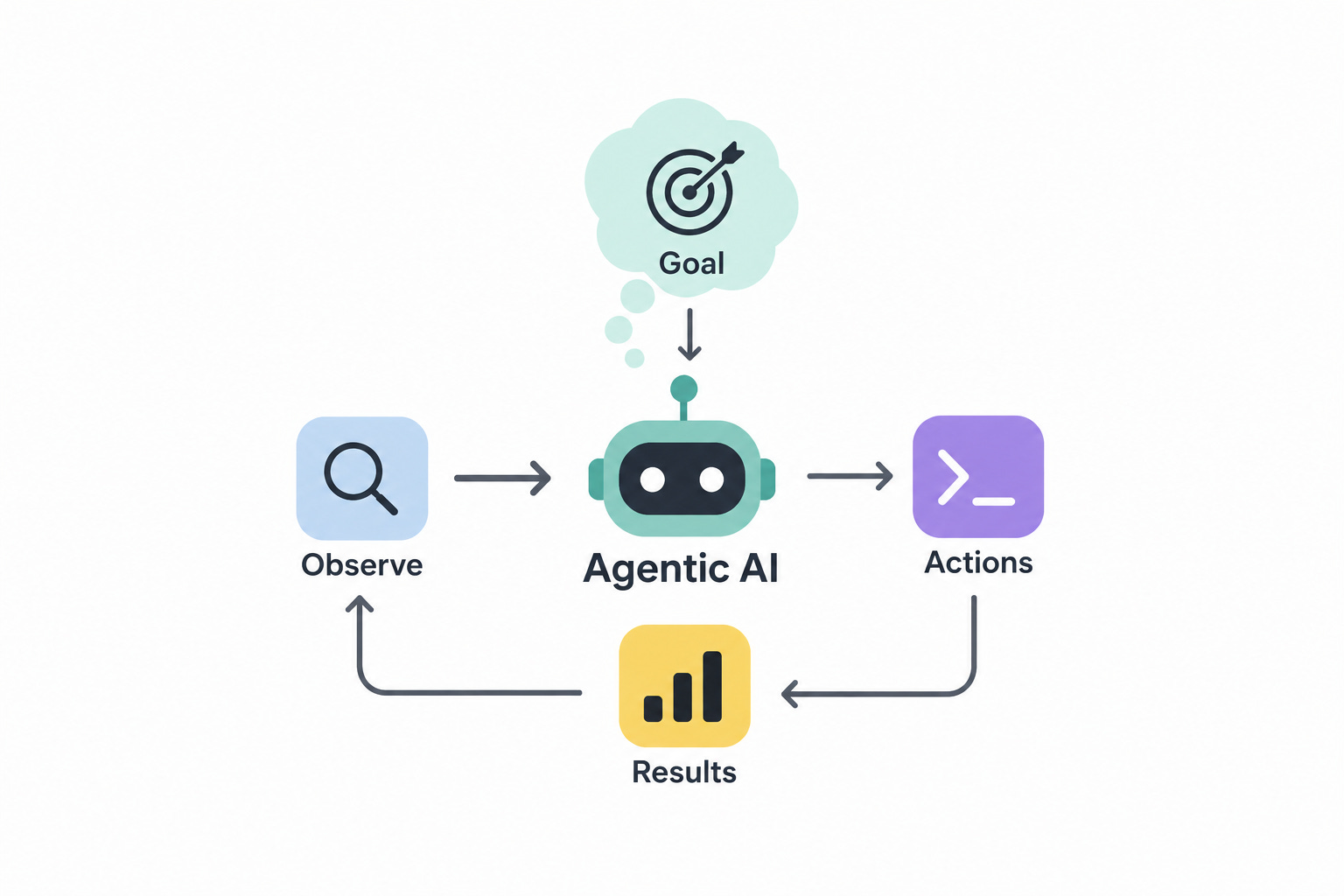
The distinction is between producing content and accomplishing tasks:
A non-agentic use of an LLM: asking it to write an email. It produces the email text. Done
An agentic use of an LLM: asking it to “find the cheapest flight next Tuesday and book it.” The AI searches flights, compares prices, decides which is cheapest, and takes the booking action. It’s working toward a goal across multiple steps, taking actions rather than just producing text
Agentic AI is usually built on top of an LLM.
The LLM provides the decision-making (what should I do next?), and additional machinery lets the AI actually take actions (search, book, send, update) rather than just describe them. So agentic AI typically uses an LLM, which is also generative AI, applied in a way that accomplishes tasks.
The reason “agentic” became a prominent term in 2025 and 2026 is that AI moved from mostly producing content (write this, summarize that) toward increasingly taking actions (do this multi-step task).
The shift from “AI that responds” to “AI that acts” is what the word agentic captures.
How the three fit together
The cleanest way to hold the relationship in mind:
LLM: the specific text technology (the engine)
Generative AI: the category of content-creating AI that LLMs belong to (the engine is one type of content-creating machine)
Agentic AI: a way of using AI, often an LLM, to accomplish tasks by taking actions (the engine put to work doing things, not just producing things)
A single AI product can involve all three.
An AI assistant that books travel uses an LLM (the text technology), which is a form of generative AI (it creates content like confirmation messages), applied agentically (it takes the actions needed to complete the booking).
The three terms describe different aspects of the same product: what technology it uses, what category that technology falls into, and how it’s being applied.
This is why the terms get used interchangeably: they often all apply to the same thing. But they apply to different aspects of it, and knowing which aspect each term describes is what clears up the confusion.
Using the terms correctly
A few quick guides for using each term accurately.
Use “LLM” when referring to the underlying text technology: “this feature is powered by an LLM” correctly names the technology
Use “generative AI” when referring to the broad category of content creation: “generative AI is changing how content gets made” correctly describes the category. Use it when the specific technology doesn’t matter or when including non-text types like images
Use “agentic AI” when referring to AI that takes actions to complete tasks: “we’re building an agentic feature that handles the whole workflow” correctly describes the action-taking application
Avoid using them as exact synonyms: calling an image generator “an LLM” is wrong (it’s generative AI but not an LLM). Calling a simple chatbot “agentic AI” is wrong (it produces content but doesn’t take multi-step actions toward goals)
The loose usage is common and usually understood in context, but using the terms precisely signals a clearer understanding, which matters in professional and technical conversations where the distinctions affect what’s actually being discussed.
Why the distinctions matter
Beyond using the words correctly, the distinctions matter for understanding what a given AI product can actually do.
Knowing something is “an LLM” tells you it works with text and has the characteristic strengths and weaknesses of LLMs (fluent output, possible hallucination, knowledge cutoffs).
Knowing something is “generative AI” but not specifically an LLM tells you it creates content but might work with images or audio rather than text.
Knowing something is “agentic” tells you it takes actions, which means it has a different risk profile than content-only AI (an agent that takes wrong actions causes different problems than a chatbot that produces wrong text).
For anyone trying to understand AI products, evaluate AI claims, or make decisions about AI tools, the distinctions are practical. They determine what to expect, what to verify, and what risks to consider.
The terms aren’t just vocabulary; they’re a map of what different AI systems actually are and do.
Where to go from here
For readers who now understand the difference between these three terms and want to go deeper, the natural next steps build on this clarity.
Understanding what an LLM actually is at the mechanism level deepens the foundation.
Learning how to write effective prompts applies the understanding to getting better results. And for those interested in the agentic side specifically, understanding how AI takes actions (through tool use and related techniques) opens up the fastest-growing area of AI development.
The core takeaway to carry forward is the nesting relationship: an LLM is a specific technology, generative AI is the category it belongs to, and agentic AI is a way of applying it.
Once that relationship is clear, the loose interchangeable usage stops being confusing, because the underlying structure is understood even when the words are used loosely.
LLM, generative AI, and agentic AI aren’t three competing things. They’re a specific technology, the category it belongs to, and a way of using it.
The confusion clears the moment you see how they nest.