
What “AI-Native Developer” Actually Means on a Job Posting
AI-native developer explained for junior developers and job seekers in 2026: the three definitions hiring managers use, how to identify which one applies, and the honest path to each.

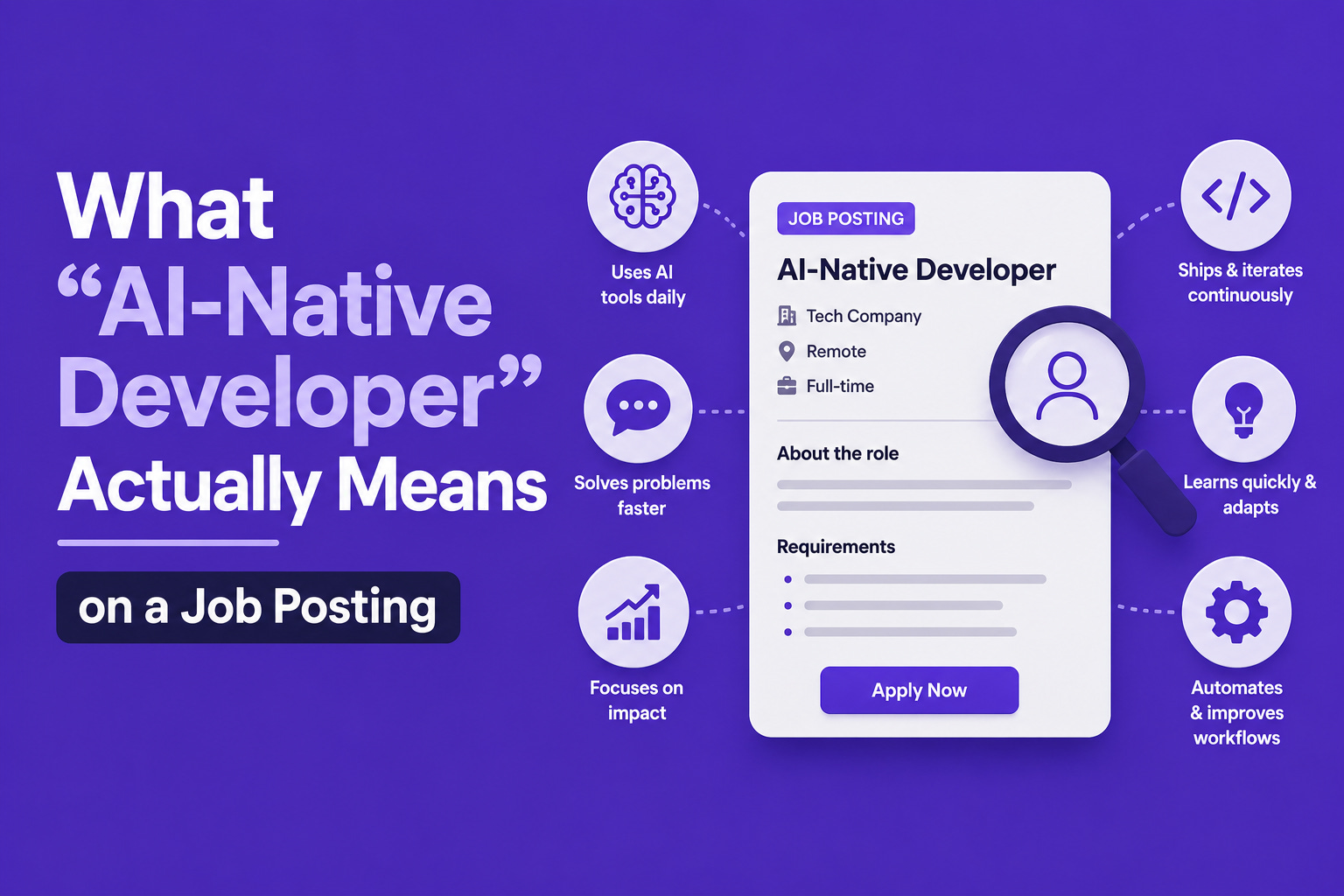
The phrase “AI-native developer” has spread across job postings in 2026 with remarkable speed. It now appears in listings from companies of every size, often without any explanation of what the term actually means.
Candidates encountering it for the first time face a real problem: the phrase sounds important, the role description rarely defines it, and applying without understanding it often leads to interview moments that go badly.
Part of the confusion is that the term doesn’t have a single agreed-upon definition.
Different companies use it to mean different things, and the meaning has drifted as the market has matured.
What started as a shorthand for “developer comfortable with AI tools” has evolved into a more specific set of expectations, but those expectations still vary significantly between companies.
A candidate calibrated to one company’s definition can sound underprepared at another.
This post breaks down what “AI-native developer” actually means in practice across the spectrum of companies using the term, what hiring managers are really evaluating when they list it as a requirement, and how to honestly build toward the skill set without resorting to resume inflation.
The goal is to give candidates a working framework for interpreting the term when they see it, so they can both apply confidently and avoid interview moments where the definition mismatch sinks an otherwise strong application.
Why this term exists at all
Understanding the term requires understanding why it appeared in the first place.
For most of software development’s history, the assumption was that developers wrote code by hand, using their own knowledge supplemented by documentation, Stack Overflow, and occasional code from colleagues.
AI-assisted coding existed in some form for years, but it was a peripheral skill, not a baseline expectation.
Hiring conversations didn’t need a special term to describe developers who used AI tools, because the use was either occasional or absent.
Three things changed this between 2023 and 2026.
The first change was the rapid adoption of AI coding tools in professional environments.
Copilot, Cursor, Claude, and similar tools moved from optional add-ons to default parts of the development workflow.
In many companies, code that was once written by hand is now substantially produced through AI suggestions, with the developer reviewing, editing, and shipping the result.
The category of “developer who uses AI tools” went from a small minority to the working majority.
The second change was the emergence of AI as a feature, not just a tool.
Products began incorporating AI capabilities directly: chatbots, summarization features, recommendations, search improvements, content generation.
Building these features required developers to understand how AI tools work as components of a system, not just as productivity aids.
The skill set expanded from “use AI to write code” to “build software that uses AI.”
The third change was the recognition that not all developers were adapting equally well.
Some developers thrived in AI-assisted workflows.
Others struggled with the new patterns: verifying AI outputs, designing systems that account for AI failure modes, judging when AI is the right tool versus the wrong one.
Hiring managers needed a way to signal that they wanted the first kind of developer, not the second.
“AI-native developer” emerged as the shorthand for the developer who fits the new environment.
The term is imprecise because the environment itself is still being defined, but it points at something real.
The three definitions hiring managers actually use
Looking at how the term shows up in actual job postings and hiring conversations, three distinct definitions are in circulation.
Knowing which one a particular company means is the first step to interpreting any specific posting.
Definition 1: The fluent tool user
The most common definition, especially in companies that primarily build non-AI products. An AI-native developer in this context is someone who uses AI tools fluently as part of their daily development workflow, knows their strengths and limitations, and ships code at a higher velocity because of it.
Signals that a posting is using this definition:
The product itself isn’t primarily AI-driven: the company builds e-commerce, SaaS, fintech, healthcare, or similar, with AI as a productivity layer rather than a core feature
The job description emphasizes velocity and shipping: phrases like “ship fast,” “high output,” or “leverage modern tools” appear in the same paragraph as “AI-native”
Required skills focus on engineering fundamentals: the job lists conventional skills (specific languages, frameworks, deployment tools) and treats AI fluency as an additional expectation, not a primary one
What hiring managers actually want here is a developer who can do good work faster than they could two years ago, because they’ve integrated AI tools into their workflow effectively.
The bar isn’t AI expertise. It’s productive AI use.
Definition 2: The AI feature builder
A more specific definition, common in companies that ship AI features as part of their product.
An AI-native developer in this context is someone who can build features that incorporate AI capabilities (chatbots, summarization, semantic search, recommendation, content generation) as production-grade components of a larger system.
Signals that a posting is using this definition:
The product has AI features as a core offering: the company builds AI-powered tools, AI-augmented workflows, or products where AI is a major feature
The job description mentions specific AI architectures: RAG, agents, embeddings, function calling, MCP, vector databases, or similar terms appear in the requirements
Required skills mix engineering with AI specifics: standard backend or full-stack skills are listed alongside experience with AI APIs, prompt engineering, or LLM application patterns
What hiring managers want here is a developer who can architect and ship AI features without needing the AI engineer to hold their hand. They aren’t expected to train models, but they are expected to integrate models into working systems thoughtfully.
Definition 3: The AI-first thinker
The least common but most demanding definition, found in companies positioning themselves as AI-first or AI-native at the company level.
An AI-native developer in this context is someone who thinks about every product decision through an AI lens by default: would AI be relevant here, what’s the right level of AI involvement, how should the system fail when AI fails, what’s the cost-benefit of adding AI versus using a deterministic solution.
Signals that a posting is using this definition:
The company describes itself as AI-native, AI-first, or AI-powered: the framing appears in the company’s About page, founder statements, and product positioning
The job description sounds philosophical, not technical: phrases like “rethink how X works in an AI world” or “build the future of Y” appear
The required skills include judgment, not just technical capabilities: phrases like “strong product sense,” “design intuition,” or “ability to evaluate trade-offs” appear alongside technical requirements
What hiring managers want here is a developer with strong product judgment, real engineering skill, and a worldview that takes AI seriously as a core building block of modern software.
This is the hardest definition to fake, because it shows up in how candidates think about problems, not just what they know how to do.
How to tell which definition a specific posting uses
The fastest way to identify which definition is in play is to read the company’s product description and the rest of the job listing together.
A few signals that reliably indicate each definition:
For Definition 1: the rest of the job listing describes a conventional engineering role with the AI mention added as a recent expectation. The product is not AI-centric. The seniority requirements focus on engineering experience rather than AI experience
For Definition 2: the listing names specific AI architectures or APIs. The role is on a team that ships AI features. The compensation tier tends to be higher than a comparable non-AI role at the same company
For Definition 3: the company’s broader marketing and product strategy is AI-centric. The job listing reads as much about worldview as about skills. The compensation is often at the high end of the market for the seniority level
A simple test: if the company would still need this role if AI didn’t exist, the posting is probably using Definition 1.
If the role exists specifically because AI features are being built, it’s Definition 2.
If the company itself would not exist or would look entirely different without AI, it’s Definition 3.
Most postings using the term are Definition 1.
Definition 2 is increasingly common in mid-sized and larger companies.
Definition 3 is concentrated in startups and a small number of larger companies that have rearchitected around AI.
The honest path to each definition
Knowing what the term means is only useful if it points to actionable preparation. Each definition has a different honest path to becoming the kind of developer the posting describes.
Path to Definition 1: Build AI-fluent daily habits
The skill being asked for is real productivity gain from AI tools, with strong judgment about when to use them and when not to.
The honest preparation is several months of deliberate AI-assisted coding, with attention to the habits that build skill rather than dependency.
Use AI tools daily in real coding work: Copilot or Cursor for code completion, Claude or ChatGPT for problem-solving conversations, structured prompts for code review and test generation
Build the discipline of verifying AI output: read every suggestion, understand what it does, reject anything you can’t defend
Develop a calibrated sense of when AI is wrong: this only comes from being wrong about AI output enough times to internalize the failure modes
Maintain non-AI coding skill: regular practice without AI assistance, so that interview moments where AI isn’t available don’t become panic moments
The interview test for this definition is usually a coding task where AI use is allowed or expected, plus a conversation about how the candidate uses AI in real work.
The conversation rewards specificity: concrete examples of when AI helped, when it didn’t, what the candidate’s process is for verifying output.
Path to Definition 2: Ship at least one real AI feature
The skill being asked for is the ability to integrate AI capabilities into production software.
The honest preparation is to build and ship at least one real AI feature, end to end, that someone other than the candidate actually uses.
The feature doesn’t have to be impressive.
A small chatbot over a documentation set, a summarization feature in a personal note-taking tool, a semantic search bar over a public dataset.
The criterion is that it has to be real: built from scratch, deployed somewhere, used by at least a few people, with the failure modes encountered and handled.
The interview test for this definition usually includes a deep technical discussion of an AI feature, often the candidate’s own project.
The conversation goes well when the candidate can describe the specific design choices, the trade-offs considered, the failures encountered in production, and what they would do differently next time.
The conversation goes badly when the candidate has only read about AI architectures without building one.
Path to Definition 3: Develop strong technical judgment that includes AI
This is the hardest path because the skill being asked for is judgment, which is built slowly through accumulated experience. There’s no shortcut.
The honest preparation involves:
Working through enough AI feature design problems to develop intuition: not just reading about them, but actually thinking through what the right architecture would be for specific scenarios
Reading practitioners who think carefully about AI in product: not the hype-driven content, but the people who write about real trade-offs, real failures, and real production lessons
Forming actual opinions: about when AI is the right tool, about which architectural patterns work and which don’t, about where the industry is over-investing and where it’s under-investing
Being able to defend those opinions under pushback: which only comes from having tested them in conversation with other engineers
The interview test for this definition is rarely a coding task.
It’s usually an extended conversation, sometimes presented as a system design problem but really evaluating the candidate’s judgment and worldview.
The conversation rewards thinking that’s specific, opinionated, and grounded in real experience. It punishes generic answers, hedging, and the kind of vague AI optimism that’s common in junior candidates.
What not to do
A few patterns that look like preparation but actually hurt the candidate when discovered. Worth naming explicitly.
Listing AI tools on the resume without real fluency. Hiring managers in 2026 know that almost every candidate has used Copilot or ChatGPT in some capacity. Listing “Copilot” or “ChatGPT” under skills tells them nothing useful and signals that the candidate is trying to inflate. The right move is to demonstrate fluency through specific accomplishments (”used Copilot to refactor X, which produced Y outcome”) rather than through naming the tool.
Claiming AI project experience without depth. A candidate who lists “Built RAG-powered chatbot” but cannot describe the chunking strategy, the embedding model, the vector database choice, or what happened when retrieval failed will be exposed in the first technical question. The interview risk is high, and recovery is difficult once the candidate’s credibility is damaged.
Using AI vocabulary fluently without underlying understanding. Some candidates prepare by memorizing AI terminology and using it confidently in conversations. This works briefly but breaks down quickly when an interviewer asks a follow-up question. Vocabulary without understanding is worse than admitting unfamiliarity, because it signals dishonesty rather than just inexperience.
Faking opinions about AI tools or architectures. Strong candidates have real opinions about which tools they prefer and why. Faking opinions usually produces opinions that are too generic (”I think AI is going to change everything”) or contradictory (”I love RAG but also think it’s overrated”). Interviewers notice. The honest version is to have opinions where opinions are earned, and to acknowledge uncertainty elsewhere.
The pattern across all four: any preparation that creates a gap between what the candidate appears to know and what they actually know creates an interview risk.
The gap will be discovered.
The discovery is worse than the inexperience would have been.
The honest framing for candidates without much AI experience yet
For candidates who haven’t built much AI experience yet, the question becomes whether to apply to AI-native roles at all.
The honest answer is yes, with the right calibration.
A candidate without deep AI experience can still credibly target Definition 1 roles, because the bar is fluent tool use and engineering competence, not AI expertise.
The preparation for Definition 1 (building daily AI-assisted coding habits) can be done in a matter of months, not years.
The same candidate should think carefully before targeting Definition 2 roles, because shipping an AI feature is a meaningful commitment and the interview will test the depth of that experience.
Without at least one real shipped feature, the application is likely to be discovered as thin during the interview.
Definition 3 roles are rarely appropriate for candidates without significant accumulated experience, regardless of how strong the candidate is otherwise.
The judgment being tested takes years to develop, and the interview is specifically designed to surface its absence.
A reasonable framing: target Definition 1 roles aggressively, target Definition 2 roles after shipping one real AI feature, target Definition 3 roles only after multiple years of AI-adjacent work.
The career path through these definitions is real, and trying to skip stages usually backfires.
What to do this week
For candidates who saw “AI-native developer” on a posting and felt uncertain whether to apply, the practical first step is to read the rest of the posting carefully and identify which definition is in play.
The signals above usually make this identifiable in two or three minutes.
Once the definition is clear, the second step is an honest self-assessment against that definition.
Not against AI in general, but against the specific definition the posting is using.
The gap between current ability and required ability is what determines whether to apply now, prepare for a few months and apply later, or target a different role for now.
The candidates who do best in this market are the ones who calibrate honestly. They apply to roles where their preparation matches the posting, they invest in the gaps that matter, and they avoid the false confidence that comes from buzzword fluency without underlying skill.
The honesty is the strategy, not just a moral preference.
The term is real. The skill is real.
The candidates who fake either get caught, and the catching is more costly than the original gap would have been.